You drink water every day, so it is natural to worry when you hear about something like chromium being found in it. The worry becomes bigger when words like chromium-6 or hexavalent chromium start showing up in search results.
But there is no need to jump to conclusions.
Chromium in drinking water health effects depend on how much chromium is present, which form is present, and how long a person is exposed to it. A water test can tell you much more than the appearance or taste of the water.
If you are using borewell or groundwater at home in Kanpur, Lucknow, or nearby areas, here is what you should know.
Chromium in water is not always the same thing
Chromium is a naturally occurring metal. Naturally occurring in soil and rock, small amounts may be absorbed by groundwater as it moves through the ground. Industry can also be a source.
You may have seen the terms chromium-3 and chromium-6 while reading about water quality. These are two different forms of chromium.
Chromium-6 is also known as hexavalent chromium. It is the form that has received more attention because of concerns about long-term exposure.
So, if your water report simply says "chromium," do not assume it means chromium-6. Check what exactly the laboratory has tested.
Why does chromium-6 matter?
The concern around chromium 6 drinking water is mainly related to long-term exposure.
The US Environmental Protection Agency has reviewed research on chromium-6 taken by mouth. The research has raised concerns about possible effects on the digestive system and cancer risk from long-term exposure.
That does not mean a person will become sick after drinking water once or twice. The amount and duration of exposure are important.
This is also why it is better to look at an actual water test instead of assuming that any detectable chromium makes the water unsafe.
What are the health effects of chromium in drinking water?
The possible chromium in drinking water health effects are mainly a concern when exposure is high or continues over a long period.
Studies on chromium-6 have looked at effects on the stomach and intestines. Long-term oral exposure has also been linked to concerns about cancer.
For a household, the practical question is usually much simpler: "How much chromium is in my water?"
That is where testing helps.
You cannot answer that question by looking at the water. It can look completely clear. It may taste normal too.
How much chromium is allowed in drinking water?
For an Indian household, the permissible limit of chromium in drinking water is an important number to know.
The Bureau of Indian Standards has set a limit of 0.05 mg/L for total chromium in drinking water under IS 10500:2012.
There is an important detail here. The 0.05 mg/L limit is for total chromium. It is not a separate limit for chromium-6.
For comparison, WHO also gives 0.05 mg/L as its guideline value for total chromium, while the current US EPA federal standard is 0.1 mg/L for total chromium. [Sources reviewed: WHO, BIS, US EPA]
|
Standard |
Chromium measurement |
Value |
|
India — BIS IS 10500 |
Total chromium |
0.05 mg/L |
|
WHO |
Total chromium |
0.05 mg/L |
|
US EPA |
Total chromium |
0.10 mg/L |
So, if you search online and find different numbers, check where the information comes from. Do not compare an Indian drinking-water standard with a US standard without looking at what each one measures.
What does this mean for homes in Kanpur and Lucknow?
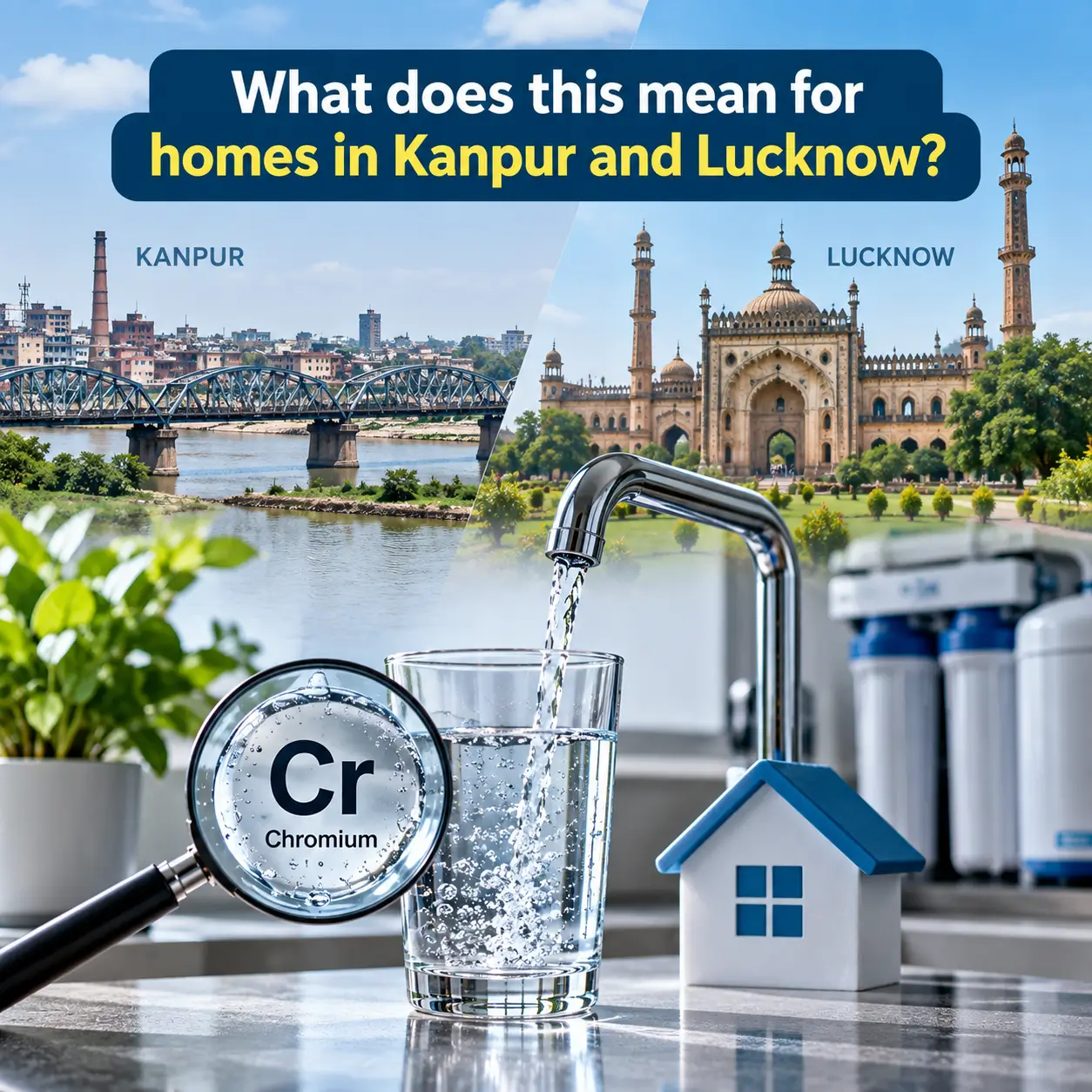
There is no single water-quality result for an entire city.
One family may use municipal water. Another may have a borewell. Even two borewells in different areas can have different water characteristics.
So we would not say that chromium water is unsafe across Kanpur or Lucknow without actual testing.
If you are using groundwater and want to know what is in it, a water test is a sensible place to start. The same applies if you have recently shifted to a new house or changed your water source.
Instead of guessing, get the numbers.
How do you test for chromium?
A normal home check cannot tell you whether chromium is present. You need a laboratory water test.
When you get the report, look beyond the word "chromium." Check whether it says:
- Total chromium
- Chromium-6
- Concentration in mg/L, µg/L, or ppb
- Applicable drinking-water limit
For example, 0.05 mg/L is the same as 50 µg/L or 50 ppb.
If the report shows a high value, do not immediately buy a purifier based on a random online recommendation. First understand the result and the water source.
That small step can save you from spending money on treatment you may not actually need.
Can RO help with chromium?
This is one of the first questions customers usually have after seeing a metal on a water report.
RO may reduce chromium concentrations, but actual removal depends on the chromium species, Ro membrane/system design, feed-water chemistry and operating conditions.
So if chromium hexavalent in water has been found in your test report, the right approach is to look at the actual result first.
At Aqua Drink, we help customers in Kanpur and Lucknow with RO installation, repair, and maintenance. If you already have a water test report, it can also give our team a better idea of the water problem before recommending a suitable solution.
A purifier is not something you should choose only because it says "RO" on the box. Your water quality should have a say in that decision.
What if your test shows high chromium?
Start with the report.
Check whether the result is for total chromium or chromium-6. Check the unit as well. If the level is above the applicable drinking-water standard, get the result reviewed and ask about suitable treatment.
It may also be worth checking other water parameters, particularly if you use borewell water. Chromium may not be the only thing worth knowing about.
And do not depend on boiling to remove it. Boiling can kill many microorganisms, but it is not a reliable way to remove dissolved metals from water.
If you already have a report and are not sure what the numbers mean, Aqua Drink can help you understand the water-quality issue and choose the next step based on your actual water condition.
Conclusion
The presence of chromium does not tell you whether your drinking water is safe or unsafe by itself. The level and type matter.
For India, the permissible limit of chromium in drinking water is 0.05 mg/L for total chromium under IS 10500:2012.
So if you are worried about the water coming from your borewell or another source, do not rely on how the water looks. Get it tested.
Know what is in your water before choosing how to treat it. If you are in Kanpur or Lucknow and need help with your RO or water-quality concerns, talk to Aqua Drink.
FAQs
-
Does boiling water remove chromium?
Ans - No. Boiling water is effective for reducing many microorganisms, but it does not reliably remove dissolved chromium or other heavy metals. If a water test shows elevated chromium, appropriate treatment should be selected based on the test result and the type and concentration of chromium present.
-
How can I test chromium in drinking water?
Ans - Chromium cannot be reliably detected through the appearance, taste, or smell of water. A laboratory water test is required, and the report should specify whether it measures total chromium or chromium(VI) and provide the concentration, usually in mg/L, µg/L, or ppb.

 Call Us Now